When Can Babies See Colour? A Month-by-Month Guide for New Parents
Your newborn can see you. Just about. At birth, a baby's visual system is one of the least developed parts of their body, and the world they see is nothing like ours. No vivid sunsets. No rich greens. Just soft blurs, shadows, and edges. The strongest thing they can detect is contrast.
When can babies see colour? The short answer is: not fully until around four to five months. But what happens in those first few months is genuinely fascinating, and knowing the timeline changes how you think about everything from the art on the nursery wall to the toys you choose.
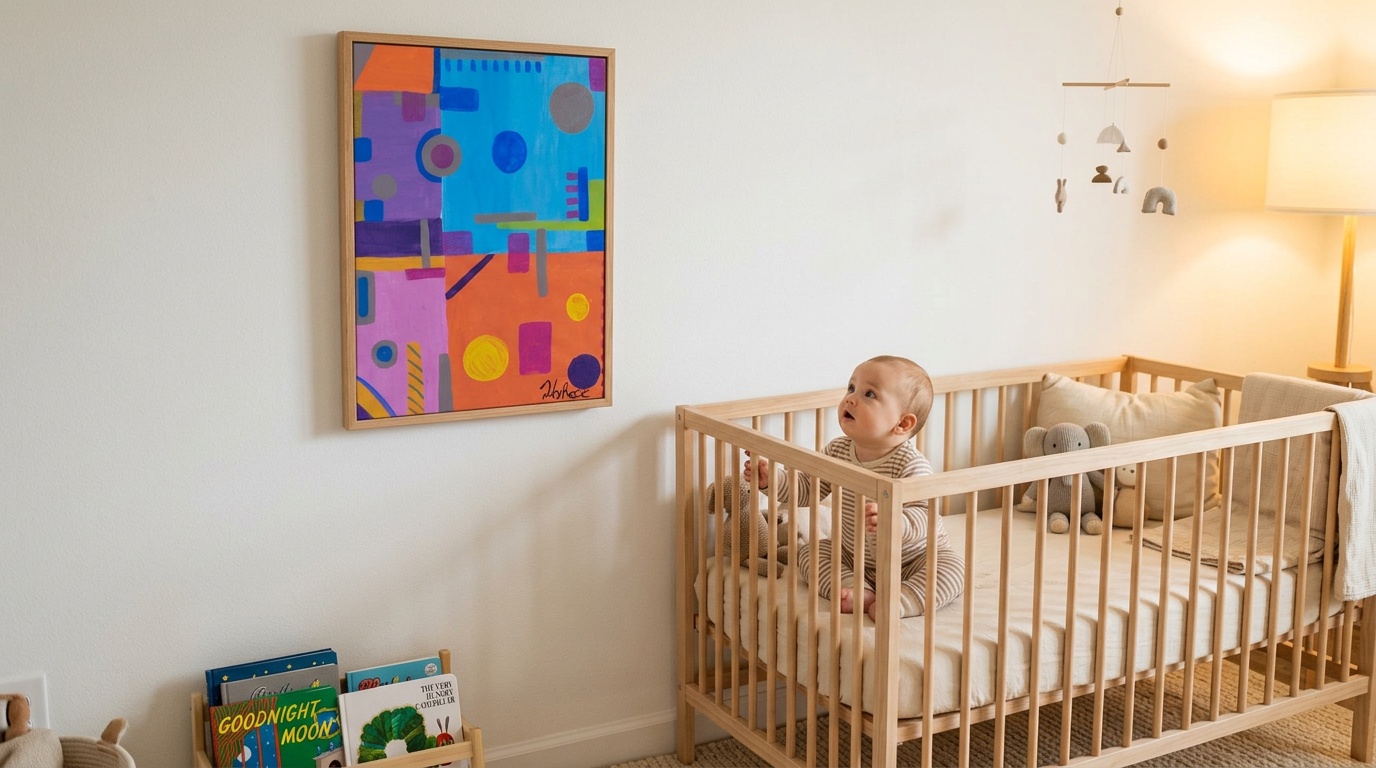
This is the guide I wish I'd had before my son was born. All the research, translated into something you can actually use.
What Newborns Can Actually See (0-4 Weeks)
A newborn's visual acuity is roughly 20/400. That means what a person with normal vision can read at 400 feet, your baby needs to be 20 feet from to see. In practical terms, they can focus best at a distance of about 20 to 30 centimetres, which is almost exactly the distance from the crook of your arm to your face when you're feeding them. That's not a coincidence. Evolution is clever.
Colour vision at this stage is essentially absent. The cone cells in the retina, which are responsible for detecting colour, are underdeveloped and sparse. Your baby is relying heavily on their rod cells, which detect light and contrast but not colour.
What newborns can actually perceive is:
- Strong contrast between light and dark areas
- Bold edges where two very different tones meet
- Movement, especially slow, sweeping movements
- Human faces, which their brain prioritises above almost everything else
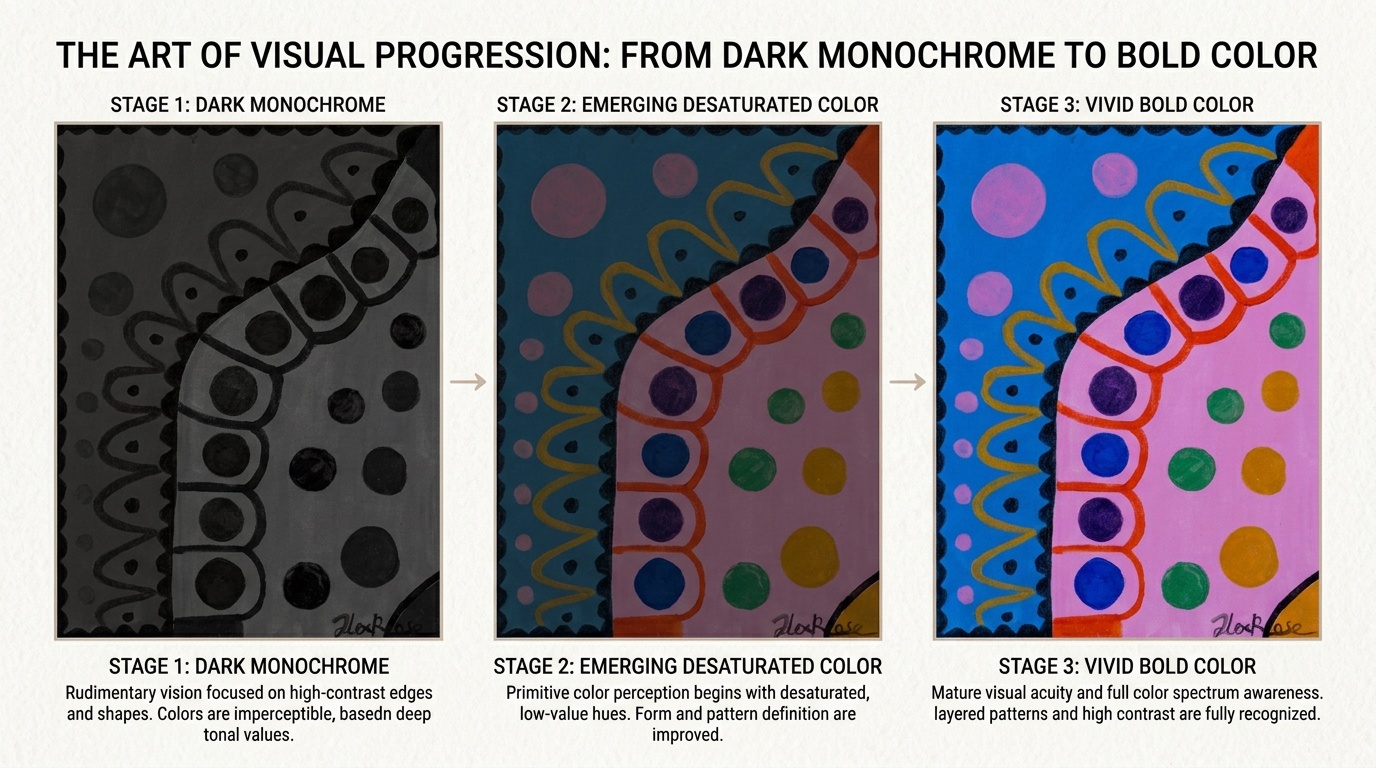
This is why classic black-and-white newborn toys and cards work so well at this stage. The visual cortex is firing hardest when it sees maximum contrast, because that's the clearest signal it can receive. The research backs this up: a 2016 paper published in the journal Proceedings of the National Academy of Sciences found that newborns show measurable visual cortex activation in response to high-contrast patterns that is significantly stronger than their response to colour stimuli alone.
Practical example: If you hang a print on the wall 30cm from where your baby lies during nappy changes, they will look at it. At birth, though, make it high-contrast. A piece like Friendly Face, with its striking figure on a jet-black background, gives their underdeveloped visual system exactly the kind of bold edge it can grip onto.
The First Colour to Appear: Red (4-8 Weeks)
Around four to six weeks, something shifts. Red starts to register.
The reason is biological. The long-wavelength cones, the ones responsible for detecting red, mature faster than the cones for other colours. Research consistently shows that red is the first colour babies can distinguish from grey, typically becoming perceptible somewhere between four and eight weeks old.
At this stage, babies are not seeing a rich, saturated red. It is closer to a warm glow, a sense that this thing is different from the grey world around it. But it is there.
This is also the age when babies begin to track moving objects more reliably, and when their attention span for a single point of interest increases from a few seconds to closer to 10 or 20 seconds. That might not sound like much, but it is significant neural development happening at speed.
What to hang now: Bold shapes with strong red elements. The Jungle Adventure print has bright concentric circles in red, orange, and yellow popping against a sky-blue background. The red elements will start to register distinctly from the surrounding colours, giving your baby their first real experience of colour contrast rather than just tonal contrast.
Blue and Yellow Join In (2-4 Months)
By around eight to twelve weeks, the short-wavelength cones for blue have also started to function meaningfully. Yellow, which requires coordination between cone types, generally follows shortly after.
At 10 weeks, your baby is beginning to build something like a full colour map. It is limited and imprecise by adult standards, but they can now distinguish between red, blue, and yellow, and will show a clear visual preference for them over muted, desaturated tones.
This is a critical period for visual development for two reasons. First, the sheer volume of new visual information they are processing is enormous, and providing rich, varied stimulation supports neural pathway formation. Second, their focal distance is increasing. At two months, babies can focus comfortably at 45 to 60 centimetres. At three months, up to about 75 centimetres.
Worked example with real distances:
Your changing table is probably fixed to the wall or near it. If your baby's eyes are roughly 30cm from the wall during a nappy change, a print hung at that height gives them a full-field view of the artwork. But by the time they are three months old, you will want to move that print slightly further away, or add one to the opposite wall, because they can now see and process at much greater distances.
At 75 centimetres, a standard A3 print (420 x 297mm) fills a significant portion of their visual field. The shapes need to be bold enough to read at that distance. Busy, intricate patterns tend to blur into a muddle. Strong, simple forms and high-contrast colour pairs, red and blue, yellow and black, orange and teal, remain clear and interesting.
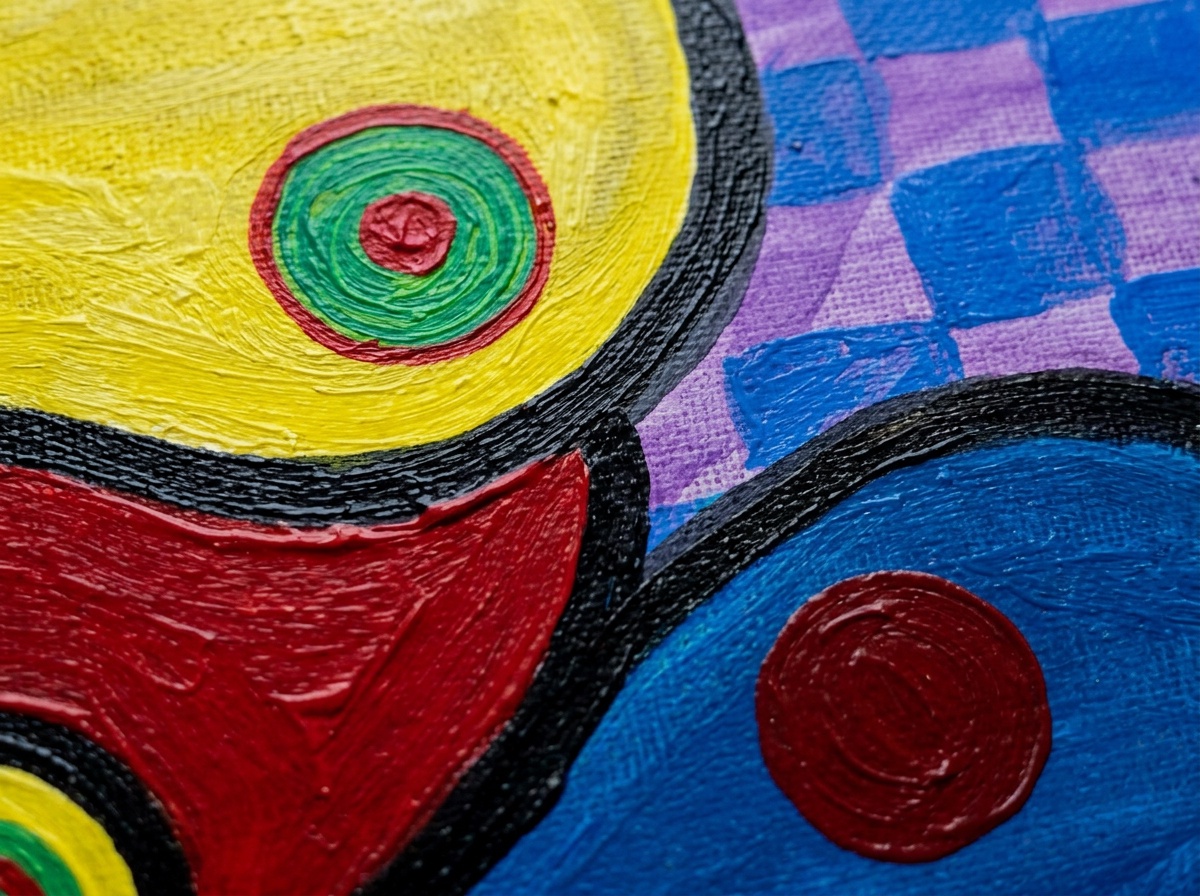
Bouncy Blobs is good for this phase. The three chunky shapes in sunny yellow, bright blue, and cherry red against a checkerboard background give developing eyes clear, distinct colour regions to lock onto and compare.
Full Colour Vision: 4-5 Months
By around 16 to 20 weeks, most babies have developed colour vision that is roughly comparable to an adult's. The cone cells are maturing, the visual cortex is processing colour information more efficiently, and your baby can now distinguish between a much wider spectrum of hues, including similar tones that were previously indistinguishable.
This is also the age when visual curiosity really takes off. Babies at this stage will spend extended periods studying complex patterns, tracking moving objects across a wide field, and showing distinct preferences between different visual stimuli. Some research suggests they prefer curved shapes to angular ones at this stage, which maps nicely onto the swirling, circular motifs in a lot of abstract art.
Focal distance is now close to adult range: three to six metres for sharp focus. This changes everything for nursery art placement. A print that was perfectly positioned 30cm away during the newborn phase now needs to compete with everything else in the room.
Practical tip: At four months, rotate your nursery art or add a larger format piece higher on the wall. Your baby is now scanning the whole room, not just the closest surface. A larger print at a distance of 1.5 to 2 metres gives them something genuinely interesting to look at during awake time in their cot.
Every baby develops at their own pace, and these timelines are averages. If you have any concerns about your baby's vision development, the NHS recommends raising them with your health visitor or GP.
Why High-Contrast Art Matters at Every Stage
The research on visual stimulation and infant development is consistent: babies who receive rich visual input during the first six months show stronger development across several markers, including attention span, visual acuity, and early spatial reasoning.
The mechanism is fairly well understood. When a baby's eyes land on something visually interesting, neurons in the visual cortex fire. Repeated firing of specific neural pathways makes them stronger and more efficient, a process called synaptic pruning and strengthening. High-contrast, visually complex images give those neurons more to work with.
This does not mean bombarding your baby with chaos. The best visual stimulation is:
- Bold enough to register at the current focal distance
- Structured enough to have clear edges and distinct regions
- Varied enough to stay interesting over repeated viewing
- Calm enough that it does not overstimulate (which you will know because your baby will turn away)
Abstract art, particularly the kind with strong colour blocks and clear forms, sits in this sweet spot naturally. It is not trying to depict realistic scenes, which require a level of visual processing your baby does not yet have. It gives the visual system exactly what it needs: clear signals.
What the Research Says
The American Academy of Pediatrics recommends providing visual stimulation during wakeful periods, particularly in the first three months. Their guidance specifically mentions high-contrast patterns and bold colours as appropriate and beneficial.
For deeper reading, a useful starting point is the AAP's developmental milestones overview, which covers vision alongside other motor and cognitive development markers in the first year.
The NHS newborn and infant visual development guidance, available through your health visitor or the NHS Start4Life resources, confirms that most babies achieve full colour discrimination by around five months.
A Month-by-Month Summary
Birth to 4 weeks: Black, white, and grey. Strong edges and contrast. Focal range 20-30cm. Faces are priority visual targets.
4-8 weeks: Red begins to appear. Tracking improves. Focal range extending to 45cm. High-contrast with warm colour accents now effective.
8-12 weeks: Blue and yellow becoming distinct. Primary colours register separately. Focal range 45-75cm. Can sustain attention on a single point for 15-20 seconds.
3-4 months: Colour vision broadening significantly. Focal range 75cm-1.5m. Pattern complexity can increase. Rotating or adding art pieces helps maintain novelty.
4-5 months: Near-adult colour vision. Full room scanning during awake time. Focal range 1.5m+. Larger prints at distance work well. Interest in complex patterns and movement increases.
5-6 months: Colour discrimination close to adult capability. Depth perception developing. Start of reaching for objects they find visually interesting.
Setting Up Your Nursery for Each Stage
The simplest way to think about this is to work with the distances.
Changing table: This is the best place for close-range art in the newborn period. Your baby spends a lot of awake time here, and at 20-30cm it is within their optimal focal range. Choose a print with strong contrast: dark background, bold shapes. Change it out or add a second piece when they hit three months and their range increases.
Cot side wall: A print at the level of your baby's head when lying down, 40-60cm away. Works well from around six weeks onwards as focal range increases. This position gets a lot of passive viewing time, so it pays to choose something with layers of detail that sustains interest over weeks. Flying Colours, with its dozen bullseyes and curving sweeps across a bright blue ground, has enough going on to stay interesting.
Across the room: From around three to four months. A larger format print (A2 or bigger) on the wall opposite the cot gives your baby something to look at during awake time when they are starting to scan the whole room. Strong colour, bold shapes, readable from 1.5 to 2 metres.
Browse the full gallery to find pieces for each stage. The descriptions for each artwork include notes on which visual features make them particularly effective for babies.
FAQ
At what age can babies see in full colour? Most babies achieve full colour vision comparable to adults by around four to five months of age. The process is gradual: red appears first at around four to six weeks, blue and yellow follow at eight to twelve weeks, and the full colour spectrum becomes accessible by sixteen to twenty weeks.
Can newborns see colour at all? Not meaningfully, no. Newborns have very limited cone cell function, which are the cells responsible for colour detection. They perceive the world mostly in contrast, light versus dark, rather than distinct colours. Some researchers suggest very young babies may have a slight sensitivity to red, but it is not the clearly perceived colour that emerges at six to eight weeks.
Does looking at high-contrast art actually help my baby's development? The evidence strongly suggests yes. High-contrast visual stimulation during the first three to six months supports the development of visual acuity, tracking, and attention. The key is providing stimulation that matches your baby's current focal distance and developmental stage. Art that is too detailed or too subtle at a given stage will not register clearly enough to stimulate the visual cortex effectively.
How far away should nursery art be from my baby? It depends on age. Newborns: 20-30cm. Six weeks to three months: 30-60cm. Three to six months: up to 1.5 metres. From five months onwards, they can see clearly across a standard-size room. Position art at the level of their eyes and adjust the distance as they grow.
What colours are best for a newborn nursery? For the first four to six weeks, black and white are most effective because contrast is everything at this stage. From six weeks, introduce bold primary colours, particularly red and blue. By three months, the full primary and secondary palette is worth having on the walls. Avoid pastels and muted tones as the dominant visual stimulation in the early months: they simply do not register clearly enough to be useful.
Should I change the nursery art as my baby grows? Yes, and it does not need to be complicated. Rotate prints between positions (close range for the changing table, medium range for the cot wall, far range for the opposite wall) as your baby's focal distance increases. Adding one new piece at three months and another at five months keeps the visual environment stimulating without becoming overwhelming.
The first six months of your baby's visual life are extraordinary. The brain is building its understanding of the world at a rate it will never match again, and what it receives matters.
Choosing art that genuinely works for each stage is not overthinking it. It is just knowing what your baby can actually see, and giving them something worth looking at. The full collection has pieces designed to work across all these stages, from high-contrast pieces perfect from birth to richer, more complex works for the four-month-plus period when colour vision comes fully online.