How to Choose Nursery Wall Art: A Practical Guide for Parents
Most parents spend weeks choosing a cot, a pram, a changing unit. The art goes up in the last 48 hours before the due date, panic-bought from a supermarket. I know because I did exactly that with my first nursery before I knew any better.
The good news: getting nursery art right is not complicated. You just need to know what you're actually looking at when you walk into a shop or scroll through a website. This guide covers the practical decisions: size, scale, colour, placement, and price. What to buy, what to skip, and why it matters more than you think.
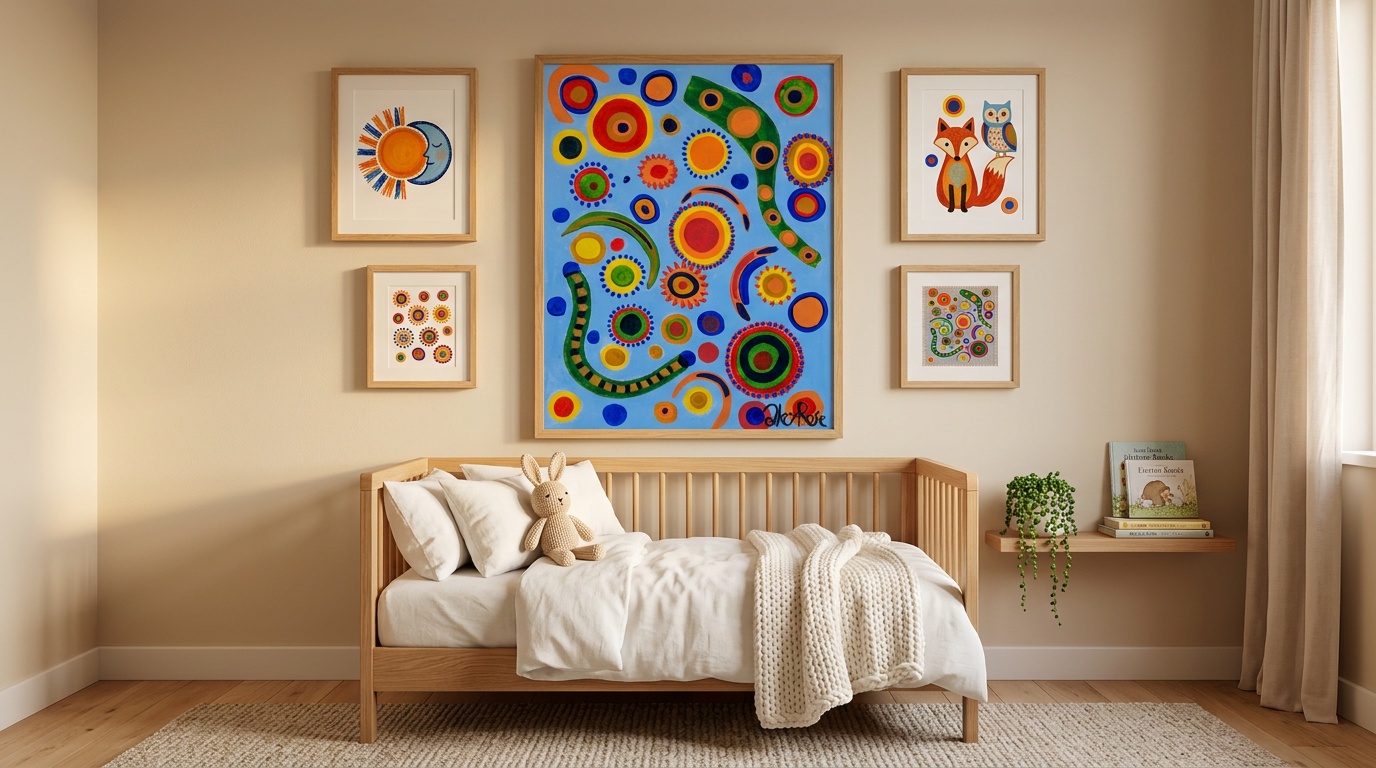
What Makes Good Nursery Wall Art for Babies
Start with what your baby can actually see. In the first three months, newborns have limited visual acuity and are most attracted to strong contrast: dark shapes on light backgrounds, bold colours against each other, clear edges. The science on this is well-documented by the American Academy of Pediatrics and most health visitors will tell you the same.
What this means practically: pastels are not your friend. Soft blush, grey, sage green, oatmeal linen print. They look gorgeous in a mood board on Instagram. Your newborn will look straight past them to the light switch on the wall, because the switch has better contrast.
Good nursery art has:
- Strong contrast between foreground and background
- Clear, readable shapes (circles, bold curves, defined forms)
- A limited but vivid colour palette (too many competing colours at similar saturation can be as hard to read as too few)
- Scale appropriate to the room and the viewing distance
Common traps to avoid:
- Prints so small they disappear on the wall
- Overly "cute" illustrated characters that are designed to charm adults, not babies
- Art hung so high that your baby never actually sees it from where they lie or sit
How to Think About Scale
This is the mistake I see most often. Parents buy a beautiful A4 print and hang it at eye level for an adult. The baby, lying in the cot two metres away, can make out basically nothing.
Scale matters in two ways. First: the print itself needs to be large enough to read from the distance your baby will be viewing it. Second: the print needs to be in proportion to the wall it's on.
A4 prints (210 x 297 mm) work best at close range: propped on a shelf or windowsill near a feeding chair, hung just above a changing table (roughly 60-80 cm from where your baby lies), or as part of a gallery wall where several prints sit close together.
A3 prints (297 x 420 mm) are the sweet spot for most nurseries. Hung 40-50 cm above the cot rail, the centre of an A3 print lands roughly 70-80 cm above your baby's eye level when they lie flat. That puts it well within their focal range in the early months, and it reads clearly as they develop through the first year.
A2 prints (420 x 594 mm) make a proper statement. They suit larger nurseries or walls with nothing else competing for attention. A single bold A2 print above a cot, centred and hung at the right height, looks like the room was designed around it.
A simple rule: if you can comfortably fit your arm across the print, it's probably the right size for a focal wall. If it's smaller than a piece of standard A4 paper, it belongs in a group of three or more.
Where to Hang It: Heights and Distances That Actually Work
There is a lot of vague advice out there about hanging art "at eye level." Eye level for whom? You? Your partner? The baby?
Here is how I think about it in practice.
Above the cot: Hang the bottom edge of the frame approximately 30-35 cm above the cot rail. For an A3 print (297 x 420 mm), that puts the centre of the artwork about 50 cm above the rail, which lands roughly 100-120 cm above the mattress surface. When your baby lies flat, they are looking up and slightly toward that point, which puts the art comfortably in their sightline without being directly overhead.
Beside the changing table: The changing table is actually the best spot in the nursery for art, because your baby has no choice but to look up during every nappy change. A print hung at approximately adult shoulder height, off to one side, gives them something interesting to stare at. An A4 Circle Dance works brilliantly here: the repeating round patterns are perfect for babies practising visual tracking.
In a reading corner or feeding chair: Art here is for slightly older babies and toddlers, when they are held upright and can look forward. Hang at seated adult eye level, about 120 cm from the floor to the centre of the print.
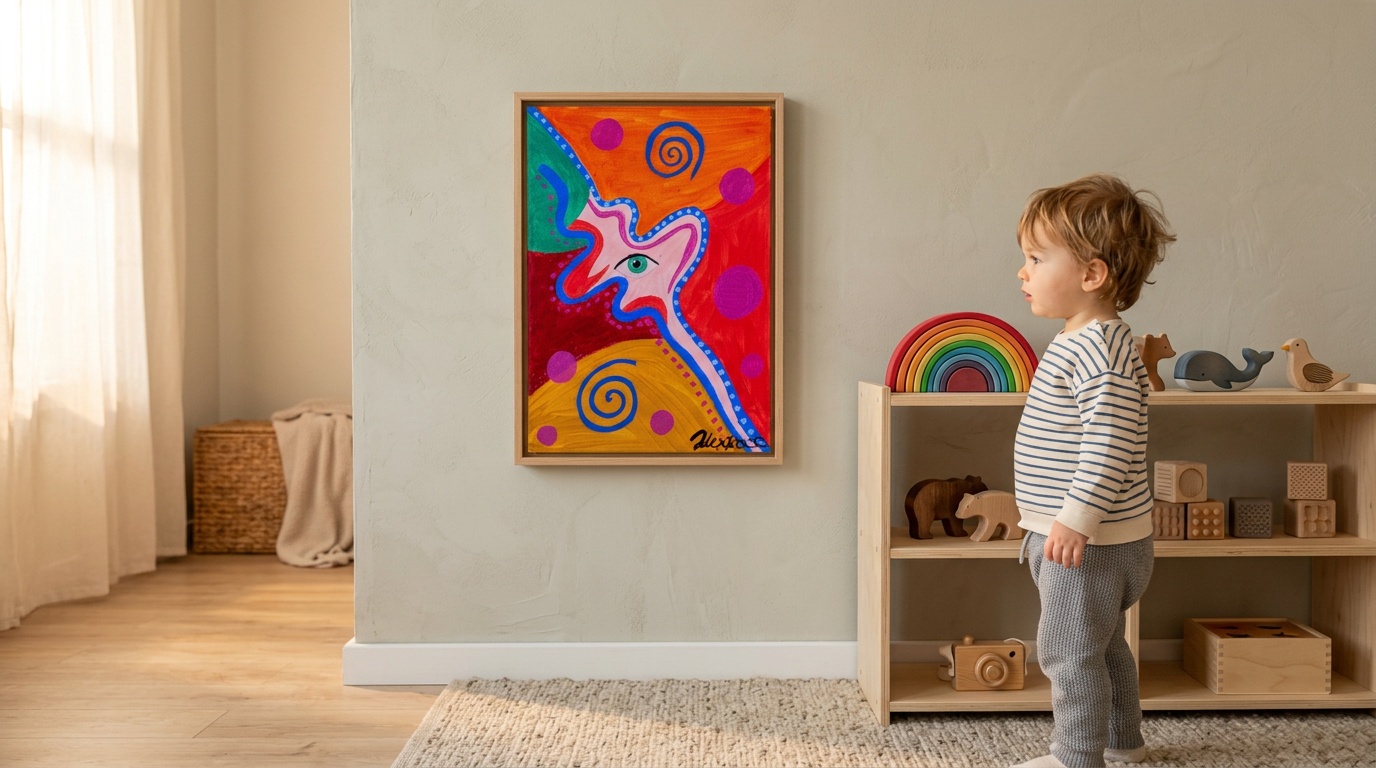
The Case for Buying Real Art
Mass-produced nursery prints are everywhere: supermarkets, online marketplaces, big-box homeware shops. They come in two flavours. Either saccharine illustrated characters (the smiling giraffe, the rainbow with a face), or generic "Scandi minimal" prints that are inoffensive to the point of invisibility.
Neither of these is designed with your baby's visual system in mind. They are designed to be purchased. Real hand-painted art is a different thing entirely. The marks, the texture, the way colour mixes at the edges: these are things a baby's visual cortex responds to in a way that a flat digital print simply cannot replicate.
I am obviously not a neutral observer here, since I paint these. But I can tell you that my own son would stare for extended periods at the paintings hanging in our house, and comparatively little at the illustrated prints we had on his nursery shelf. The contrast was obvious enough that it changed how I thought about my work.
The other argument for real art: it lasts. A themed nursery with matching wallpaper, coordinated bunting, and a specific illustrated character set has a shelf life of about eighteen months. Your child will outgrow the theme. Abstract art grows with them. Bouncy Blobs looks as good in a four-year-old's bedroom as it does in a nursery. Robo Friend will survive a bedroom rebrand without anyone needing to repaint.
Comparing Nursery Art vs Mass-Produced Prints
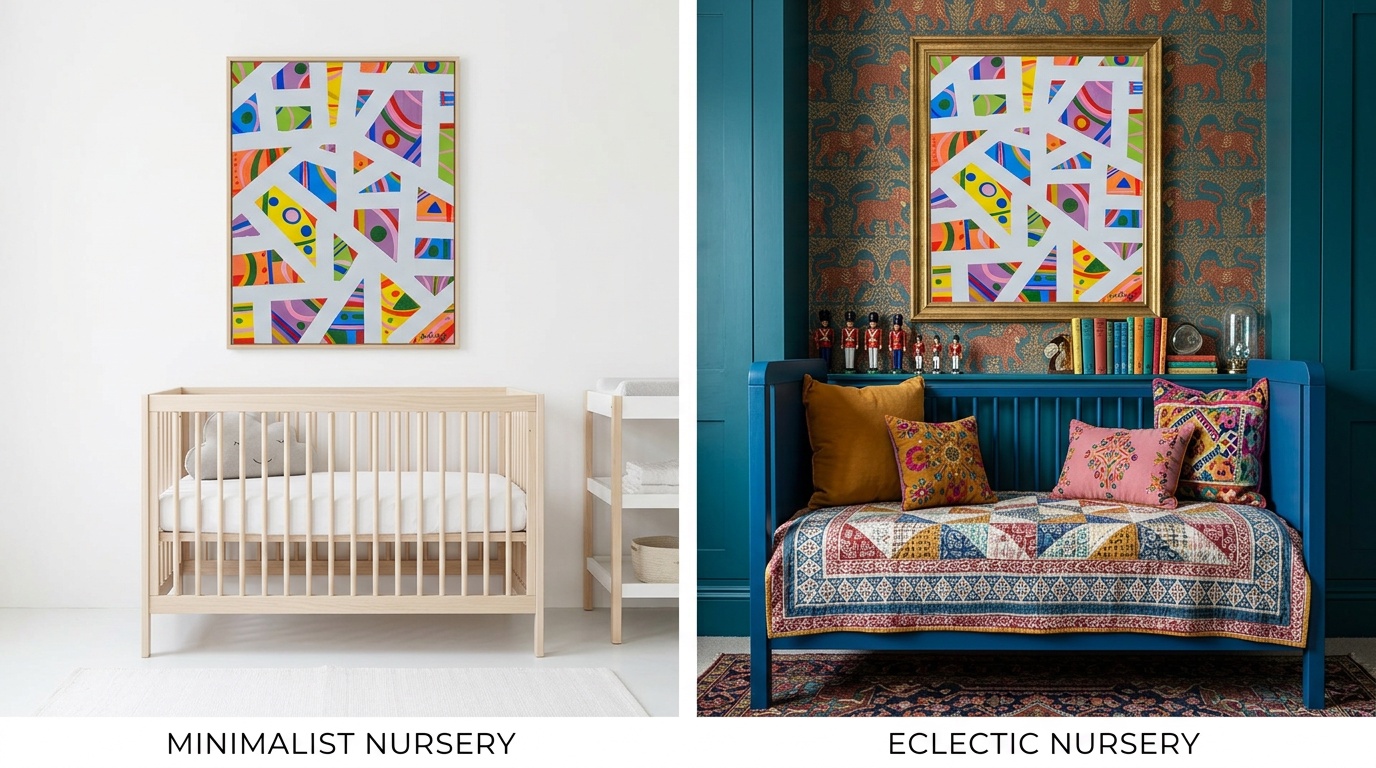
The visual difference between high-contrast art and pastel nursery prints is significant. On the left, muted tones and illustrated characters with soft outlines. On the right, strong shapes with clear edges and vivid colour contrast. From two metres away, with the visual acuity of a three-month-old, the right-hand image is the one that registers.
This is not about aesthetics. It is about what is actually visible to a developing visual system.
Budget Breakdown: What You Get at Each Price Point
Nursery art does not need to be expensive. Here is what different budgets buy you.
Around £19 (A4 print): An A4 fine-art print of a hand-painted original. Good for close-range viewing: beside the changing table, on a shelf, as part of a gallery wall. Not the right choice as a solo piece above a cot, but excellent value if you want to try a few pieces and see what your baby responds to.
Around £29 (A3 print): The format I recommend for most nurseries. Large enough to be seen clearly from across the room, small enough to sit well on a typical nursery wall without overwhelming the space. An A3 Dreamy Bubbles or Jungle Adventure as a single focal piece above a cot is the simplest and most effective nursery art decision you can make.
Around £45 (A2 print): A statement piece. If you have a longer wall or a larger nursery, an A2 print shifts from decoration to focal point. It anchors the room. Three Friends at A2, hung on a white wall above a neutral-toned cot, is visually striking enough to make the room feel intentional and designed. Worth it if you are planning on keeping the print as the room evolves.
A gallery wall of three A4 prints costs the same as one A3, and covers more wall area. Both approaches work. The gallery wall takes more planning but gives the room more visual texture.
How to Build a Nursery Gallery Wall
A gallery wall sounds complicated but the principle is simple: three to five prints in a loose horizontal or L-shaped cluster, with consistent gaps between frames (I use 8-10 cm, which looks intentional without being rigid).
A starter three-print gallery wall:
- Centre: one larger piece, A3, as the anchor
- Sides: two A4 prints, either matching or deliberately contrasting
Good combinations from the collection:
Option 1: Bold and graphic. Robo Friend at A3 in the centre, with Peek-a-Boo and Rainbow Shapes at A4 on either side. All three have strong geometric qualities that read clearly as a group.
Option 2: Softer with punch. Dreamy Bubbles at A3 centre, with Sunny Blooms and Candy Swirl at A4. The colour palette moves through pinks, oranges, and blues without clashing.
Option 3: Maximum contrast. Friendly Face at A3 centre (the dark background makes it a strong anchor), flanked by Flying Colours and Swirly Dancer. This combination has the most visual energy and works best on a large white wall.
Before you put anything on the wall: cut paper templates to the exact size of each print and hold them up with painter's tape. Stand back. Live with it for a day. The arrangement that looks right in your head often needs one or two adjustments when it is actually on the wall.
Why Art Beats Themed Wallpaper or Vinyl Decals
Themed wallpaper is a trap. It looks brilliant in the nursery reveal photos. It looks exhausting twelve months later when your child has moved on from that particular animal character, and you are faced with either living with it for another five years or repainting the entire room.
Vinyl decals have a similar problem. They are hard to remove cleanly, they limit where you can hang other things, and they read as decoration-as-afterthought rather than considered design.
Framed prints solve both problems. You can move them. You can swap them. You can take one down, put up something new, and rehang the original in a different room. That flexibility is worth paying for. A £45 print that works in a nursery, a toddler's bedroom, a playroom, and eventually a teenager's room has a far better cost-per-year than a £12 decal set you are stripping off the wall in two years.
Practical Materials and Framing
The print itself should be on heavyweight, archival-quality paper. This matters because nurseries can be humid (especially if you use a humidifier, which many parents do in the early months), and thin paper will buckle and distort in humidity.
For framing, simple black or white frames with a small mat (passepartout) make any print look considered. Avoid clip frames for baby rooms: the glass is not safety-glazed and they feel temporary. Avoid ornate frames: they fight with bold art rather than supporting it.
Hang with two picture hooks rather than one for anything A3 and above. A single hook lets the frame tip over time, and you will spend the next six months realigning it.
Checklist Before You Buy
Before adding any piece of nursery wall art to your basket, run through this quickly:
- Will this be visible from where my baby actually spends time? (Cot, changing table, play mat)
- Is the print large enough to read clearly from that distance?
- Does it have genuine contrast, or just colour variety?
- Is the frame appropriate for a baby room? (Safety-glazed, secured properly)
- Can this art grow with my child into toddler and preschool years?
If it passes all five, it is a good buy.
Frequently Asked Questions
What size nursery wall art should I buy?
A3 (297 x 420 mm) is the most practical size for the majority of nurseries. It is large enough to be seen clearly from across the room, and proportionate to a standard nursery wall. Go up to A2 if you have a larger wall and want a single focal piece. Use A4 for close-range spots or as part of a gallery wall.
How high should I hang nursery art above the cot?
Hang the bottom edge of the frame approximately 30-35 cm above the cot rail. For a standard A3 print, this puts the centre of the artwork roughly 50 cm above the rail and about 100-120 cm above the mattress. This keeps it within your baby's sightline without putting anything directly overhead.
Is pastel art actually bad for babies?
Pastel art is not harmful. It is simply harder for babies to see, particularly in the newborn period when visual acuity is still developing. Your baby is not going to suffer from looking at a pale watercolour print. It just will not hold their attention the way bold, high-contrast art does. For a room that supports visual development, bold colours are a better choice.
Can I use the same art as my baby grows into a toddler?
Abstract art ages well. Unlike illustrated "baby" themes, abstract prints do not have a narrative your child will grow out of. The same painting that fascinated your newborn will still look at home on a four-year-old's bedroom wall, and probably a ten-year-old's too.
How many pieces of art should I put in a nursery?
One strong A3 piece is enough for a simple, uncluttered look. A gallery wall of three to five A4 prints creates more visual interest and gives your baby more variety to look at. More than five pieces on one wall starts to feel busy and can dilute the impact of any individual print.
What is the best nursery wall art for newborns specifically?
Newborns respond most strongly to very high contrast: dark shapes on light backgrounds, or vivid colours against each other with clear edges. Friendly Face and Three Friends both have strong dark-on-light contrast that works especially well in the first three months. Circle Dance and Flying Colours are excellent slightly later, when babies start tracking moving patterns with their eyes.
You can browse all available prints at the full gallery and filter by style. If you are not sure where to start, the pieces I recommend most often for first-time nursery buyers are Bouncy Blobs at A3 (the checkerboard background gives it exceptional contrast) and Dreamy Bubbles for something a little softer. Both work at every size and hold up as the room changes.